Interview with Assareh Assa
Most of this interview was conducted in Paris by members of Communisme Libertaire in September 2025; the last questions were posed by a Rail editor in late January 2026.
https://brooklynrail.org/2026/03/field-notes/one-uprising-after-another/
Rail: Can we start by going back to the 2022 uprising, “Woman, Life, Freedom”?
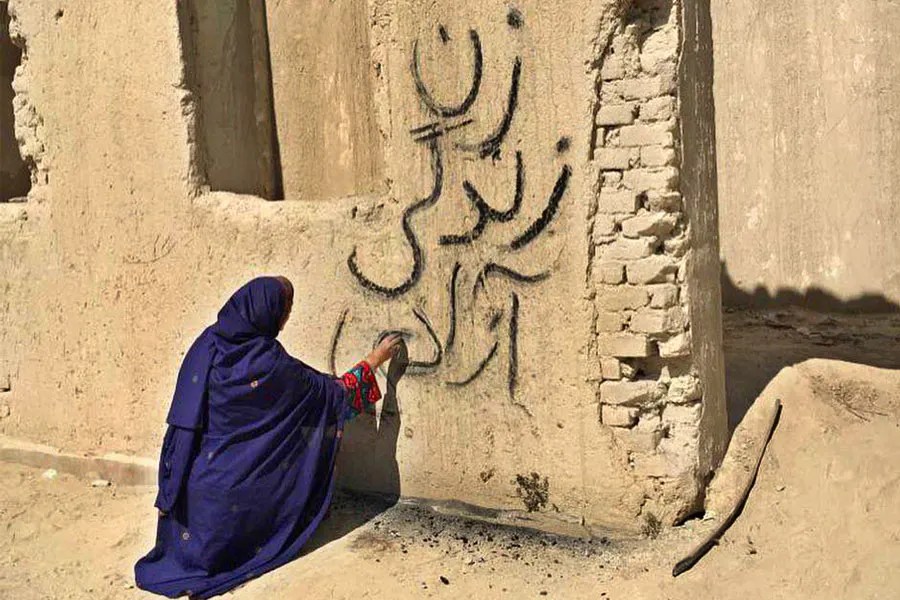
Assareh Assa: We have just passed the third anniversary of the murder of Jina Amini, a young Kurdish woman arrested in Tehran by the morality police for being incorrectly dressed, according to the regime’s definition.1 She was beaten on the head, which caused her death a few days later, on September 16, 2022. During her funeral, the inhabitants of Saqqez, where she was born, wrote on her gravesite, “Jina, you will not die. Your name is our password.” I would like to pause at this sentence, which turned out to be true. Jina’s name quickly became a thread connecting all those wishing to overthrow the current regime in Iran. Large demonstrations broke out everywhere: we witnessed magnificent scenes of solidarity, courage, and rage in all corners of the country. However, I must add that Jina’s name also gave rise to a deep division within Iranian society. Jina was actually not the official name of this young woman—a victim of the structural misogyny of the Iranian state—but her Kurdish name. This is why it is important to understand whether this phase of the movement in Iran is called the “Jina uprising” or the “Mahsa uprising.” The choice of name is not neutral and reveals the user’s political position. Reactionary currents prefer “Mahsa”: what seems a simple word choice contains a truth which, along with state repression, is one of the reasons for the failure of the movement.
Rail: By speaking of the movement’s failure, do you mean to say that it achieved nothing?
Assa: No. The “Woman, Life, Freedom” uprising changed the way the cities look, especially the big cities. With respect to women’s appearance in society, there is undeniably a before and after to this revolt: today, women can dress with relative freedom, despite the state.
Rail: Is it like before 1979?
Assa: Indeed, under the Shah, women did not have to wear the veil. Nonetheless, it is not true that all women enjoyed individual liberty in the time of the Shah. Before the Revolution, upper-class women—from the bourgeoisie and the petite bourgeoisie—went out unveiled, unlike working women and sub-proletarians. There was certainly no morality police, but in the little towns and villages traditional relations were much more anchored. Both male and female members of the family prevented a young woman from dressing as she wished, even inside the house. I would also like to add that the Shah’s father, considered by some “the father of modern Iran,” violently attacked women for going out in society wearing the veil. The Islamic Republic brutalizes in the opposite direction.
In any case, after the Jina uprising, the regime made a big effort to prevent women from going out unveiled. It notably killed a young girl in Tehran who refused to wear the veil. It also approved a law spectacularly restricting the rights of women, but it has not been able to enforce it in the face of women’s determined resistance. But it must be stressed: we are speaking of relative freedom. The women of the wealthier classes enjoy much more of this individual freedom. Sometimes we can see on social media scenes which it is difficult to believe are taking place in Iran. But then we see that it’s a party for kids of the wealthier classes. The working class observes the pleasures of this individual freedom from a distance. It must be added that a woman’s life remains two times cheaper than a man’s, that abortion is forbidden, and that—in pursuit of a natalist policy—the regime makes it increasingly difficult for women to have access to contraception. Certainly, the regime has retreated in the face of women’s desire to wish to appear “freely” in society, but this individual freedom is accompanied by bitterness. If we remember that early on people shouted in the street, “The veil is a pretext—we want the fall of the regime!” this bitterness is understandable. If we consider the question of the veil, that of women, that of political freedom, and that of bread as the four pillars of the Jina uprising, only individual freedom, to a limited extent, has been won. In this sense, if we don’t lose sight of the fact that it was a radical revolt against the whole theocratic state, it seems to me that it is not wrong to say that the movement failed. What is important is to understand the reasons for this failure.
Rail: You mentioned the repression, but also the question of what the movement was called.
Assa: Yes. Without a doubt, the bloody and merciless repression of the uprising was an important cause of its failure; thousands of demonstrators were wounded and killed, other thousands were arrested and tortured, hundreds were condemned to death, of whom eight were executed—the last one a few weeks ago, as the movement’s anniversary approached. It is important to note that these people came from the working class. They were either working women or came from working-class families. In other words: the regime allows itself to kill opponents who don’t have the support of the petite bourgeoisie or the bourgeoisie, people who have no social voice.
The repression does not stop at militants directly tied to the movement, but has expanded to all sorts of oppositionists. To give only one example: the regime condemned a working woman militant, Sharifeh Mohammadi, to death. This is something practically unknown, it must be said. The regime already executed thousands of Communist women and Mujahideen during the Black Decade after 1979, along with several Kurdish female peshmerga. (Today, two Kurdish women have been condemned to death and a third to life imprisonment.) But the fact that they are bearing down on a simple working woman for her activities within the workers’ movement shows that they mean to teach a good lesson to that dangerous class. To that I must add that, with the goal of imposing a reign of fear on society, the regime has accelerated the executions of non-political prisoners during the last three years. More than three thousand individuals have been executed—a rate of three per day. This is why, reacting to this aspect of the repression, a resistance movement has formed inside Iranian prisons. Hundreds of thousands of imprisoned women and men have gone on hunger strike every Tuesday to make the rest of the population aware of the relentless executions. But, so far as I know, this resistance has until now not found an echo in Iranian society as a whole. In a word, the intensity of the police repression has strongly weakened the movement. However, I think it would be wrong to consider the repression as the only reason for the failure of this phase of the movement. I would even go so far as to say that what has reassured the regime about the efficacy of its repression constitutes the fundamental reason why the Jina uprising had so many victims without achieving its objective: overthrowing the regime.
I seek an explanation in the symbolic aspect of the first name, “Jina.” This name symbolizes a strong identitarian relation to a region in Iran, Kurdistan, which since the birth of the Islamic Republic has posed a challenge to Iranian nationalism. By opting for “Mahsa” instead of “Jina,” the more nationalist elements showed their intolerance towards the movement of the Kurdish people. One can approve or disapprove of the goal of this movement—the establishment of a Kurdish nation-state—but one can not and should not ignore it, as even certain elements of the Iranian left do. The refusal to use Jina’s name symbolizes above all the desire of Iranian nationalists to deny the existence of such a movement in Kurdistan. The regime has drawn support from this nationalism, or rather the pan-Iranian tendency, to halt the movement and put off the danger of its overthrow. What has limited the movement’s radicalism is without a doubt the Iranian nationalists’ fear of what they call “separatists”—Kurds, Arabs, Baluchis, and others. For example, when Kurdish prisoners arrested for their political activities were executed right in the midst of the “Woman, Life, Freedom” movement, few people in the center of the country were bothered by it. I wish simply to draw attention to an incurable sickness within Iranian society. For various reasons, a good number of Iranians feel a strong sentiment of nationalism, which has always helped the Islamic Republic in its most difficult moments—the latest example being Israel’s attack on Iran.
Rail: We’ll come back to this point later, but first, could you say a little more about the way in which nationalism has contributed to the failure of the movement?
Assa: While an unexpected and surprising solidarity among these various ethnic groups was observable at the start of the movement, there was a later division on the question of territorial integrity. This division crystallized when the son of the Shah, taking advantage of the situation, proclaimed himself the most likely candidate to govern the country after the fall of the regime. He and his entourage began a campaign under the slogan [here translated to English] “I delegate to the prince,” suggesting that people give their vote to the prince. Although this campaign was a political scandal for the royalists and led to nothing, it was harmful enough to break the enthusiastic solidarity among the ethnic groups and orient the political struggle of the most radical elements against the royalist current. This was obviously only beneficial for the regime, which fully profited from it. This is why, in my opinion, there are good reasons to suspect that the regime itself has strengthened the royalist current. It is quite intriguing to note that those currently hanging around the Shah’s son—who was quite isolated and actually a nonentity on the Iranian political stage a few years ago—are former regime reformers, who collaborate closely with the leaders of the Islamic Republic! The son of the Shah has on many occasions signaled that he intends to preserve the current forces of repression—the military, the Revolutionary Guards, etc.—when he ascends the throne.
The Islamic Republic is always in favor of a corrupt opposition. A few decades ago, it was the Mujahideen who played this role. Today, it prefers the opposition to crystallize around the son of the Shah, not only because it makes it easier to control and repress the opposition but also because it knows that there is a deep split between the royalists and the more left wing elements of society—or even just those who have not forgotten the corruption of the royal regime. But it also knows that as long as it can depend on Iranian nationalism, it can put off its fall. This is why, it seems to me, the royalist forces are its best allies.
Rail: Can we consider the nationalism promoted by the royalist current as one of the reasons for the Jina movement’s failure?
Assa: I would say yes and no. While nationalism has played a disastrous role in recent years, it should not be thought that it was introduced into the movement by the royalists. We need to abandon the dualistic approach, according to which an idea “penetrates” a “mass,” with the latter becoming active when the idea “takes over.” In other words: ideas are not fabricated by a handful of intellectuals or politicians, then imposed on the masses. Unfortunately, many people think that it is because of the royalists that the Jina movement was put down in blood. Certainly, there is something to this idea, but it is only superficial: the role of the royalist forces certainly led to blocking the movement. But the royalists could not have played this role if their point of view was not already present in society, if they didn’t already have a popular base, or if conditions did not already exist for these things to be true. Certain comrades still refuse to accept this.
There is in truth a solid social base for this reactionary force to exist and act. It seems to me that one could explain this base under three headings: politics, ideology, economics.
During the last few years, royalism has been promoted politically by a media campaign that pushed the idea that Iran had its golden age under the Shah, and that the country had been rapidly modernizing under the leadership of the Pahlavi dynasty. Thanks to this campaign, the royalists have been able to present themselves as a progressive element. Thanks for this go to the Islamic Republic. This may seem paradoxical, and yet it is true! Indeed, by forcibly eliminating the most radical elements in society—that is, the Communists—the Islamic Republic succeeded in making itself the only narrator of the history of the revolution: by eliminating a part of the protagonists of the 1979 revolution, it has been able to censor the history of the revolution against the Shah and tell it in line with its own interests. In their telling of the story, we hear nothing of the poverty of the working class, the confinement of sub-proletarians in slums on the edge of Tehran, the class struggle, or the absence of political freedom—everything that impelled the Iranians to rise against the dictatorial regime of the Shah—but only of the wish to meet the challenge of the Western world and establish religious order in society. Young people, who know only this story even while living through the wretchedness engendered by a theocratic regime, ask themselves, “Isn’t the whole thing completely crazy?” This was taken up by the royalists, who have made their own myth out of it: at the time of the Shah, everything was for the best, everything was harmonious and functioned well; it was the madness of a well-fed people that spoiled everything. This is why I insist that it is the Islamic Republic itself that has given royalism a second chance. Thanks to its falsified narrative of the 1979 revolution, it has made possible the claim to the throne made by the Shah’s son, at least in the eyes of part of society. Some people are better informed, and do not forget the corruption of the court and the poverty of the destitute classes, but they commit the logical error of thinking the epoch of the Shah, though dark, was better than the regime of the ayatollahs—as if these were two distinct phenomena, not one linked in continuity.
With respect to the economy, the Iranians—and especially the constantly shrinking middle class—find an escape from their deplorable situation, largely caused by the regime’s geopolitical strategy, in the idea of renewing economic relations with the West—or, to put it more simply, in becoming a “normal” country. But by “normal country,” they mean a country where capitalism functions “normally.” There is no need for me to point out that capitalism has never developed in a “normal” fashion; in any case, the liberals peddle a dream of a “normal” capitalist economy. Experts close to the royalist current take a part of the history of capitalism in Iran, “modernization,” and associate it with the Pahlavi dynasty, as if it was thanks to the benevolence and the patriotism of the Shah and his father that Iran underwent considerable economic development. It is obviously much more complicated to explain the modernization of Iran as a function of global relations of capital in the years following the Second World War than to explain it by the luck of the Iranians in having a benevolent king! This leads automatically to the question: can we set in motion the same economic policies and achieve the same goals as more than fifty years ago? A part of society, recalling the life of the well-off classes under the Shah’s regime, think that the economic catastrophe through which they are currently living would end if the Shah’s son would take power.
Ideologically, the values incarnated in royalism—like racism or archaic relations between men and women—are still very present in a part of the Iranian population. It is therefore not astonishing if royalism, after a long hibernation, has woken up and demands power. It is not that royalists or reactionary elements generally manipulate the movement; the fact that they have a large enough margin of maneuver on the political scene demonstrates above all that royalism expresses the wish of a part of society. I myself think that it is very dangerous for militants against the Islamic Republic, here or abroad, to ignore the elements of the population who favor the existence of a reactionary political current like royalism.
Rail: Do you think that royalism is returning to Iran?
Assa: Not really. Actually, Iranian society is heterogeneous: not only are there national aspirations among various ethnic groups in opposition to Iranian nationalism, but we also don’t know the levels of royalism in different social classes, which makes it difficult to evaluate its strength. As far as I have been able to see, I can only say that the idea of having a king does not bother part of the Iranian population. If I emphasize this point it is not to overemphasize people favorable to royalism, who are not numerous, but simply to acknowledge their existence. This aids us to see what is blocking the revolution: nationalism. This also lets us show that the royalists and the partisans of the Islamic Republic are allies in hindering the revolutionary process.
Besides, I avoid making predictions. What is clear is that the political situation of the regime is very unstable: many are waiting for the second phase of the Israeli attack, while the economic bankruptcy of the regime lets us foresee a popular uprising soon [as of September 2025]. The royalists are counting on Israel to deal a fatal blow to the Islamic Republic, while hoping for a popular uprising supporting them. However, their call for people to go into the streets when the Israeli armed forces were bombing the cities was not followed by anyone.
Besides, I think that Iran’s geopolitical situation is important enough for the global powers not to be indifferent to its fate and the political form and structure it will take after the eventual fall of the current regime. In truth, the royalist forces want us to believe that royalism is a preexisting alternative, but until now the son of the Shah has not been taken seriously by the rulers of the Western countries. His best ally for the moment is Israel. Recently, the son of the Shah went to Israel to prepare for the fall of the regime. This initiative gave rise to numerous criticisms—even within the royalist camp—from nationalists opposing the idea of entertaining relations with a foreign power that has attacked their country.
Rail: Let’s return to the war between Israel and Iran. You have said that Iranian nationalism aided the Islamic Republic. Can you say more about this?
Assa: In fact, every attack against a country generally gives rise to nationalist sentiments among its population. In the Iranian case, the situation was particularly ambiguous during the conflict between Iran and Israel, which has been called the Twelve-Day War. The immense majority of Iranians profoundly detests the current regime, because of the violence and brutality it shows towards its opposition. Since they feel incapable of ridding themselves of it, they are happy to see their oppressors suffer mortal blows. Without a doubt, Israel’s reprisals against the commanders of the Islamic Republic gave pleasure to the majority of the Iranian population. Although national feeling was wounded by the Israeli bombing, a large part of the populations is passively awaiting Israel’s next attack to definitively get rid of the Islamic Republic: it considers the Israeli military actions a good thing. It must unfortunately be said that the idea of being “liberated” by a state like Benjamin Netanyahu’s, whose fascist nature has long been known, does not bother a part of the Iranian population. This indifference is partly explained by the fact that the liberals try to portray Israel as the only real democracy in the Middle East—a state that functions, that guarantees freedom of expression and economic security to its population, etc. We know that this is not true, but Iranian society appears very far from seeking the truth about the Israeli regime. This is due to the discourse of the Islamic Republic throughout its existence.
I would like to pause for a moment to consider this point: Iran was culturally opposed to the Israeli occupation of Palestine long before the birth of the Islamic Republic. In making the Palestinian cause a cause of the state, it altered the way Iranians see the Israeli-Palestinian conflict. In effect, by trumpeting the Palestinian cause in repressing the Iranian population, it made it detestable in the eyes of many Iranians. For example, some time ago, the regime organized a parade of Bassijis—young pro-regime women employed to attack women who go on the street unveiled—carrying the Palestinian flag.
Nonetheless, it is not only the utilization of the Palestinian emblem that leads Iranians to believe that the regime’s repression is bound up with a pro-Palestinian discourse. Actually, during its whole existence, the Islamic Republic has carried on a foreign policy whose direct result for the Iranians has been their endless impoverishment. Obviously, one can and ought to seek the reason for this devastating policy in the economic interests of their leaders. But for an average Iranian, the regime gives Iranian money to countries that it considers allies in the “Axis of Resistance”—notably, the Palestinians. This is why in recent years we heard—and still hear today—this slogan at assemblies and demonstrations: “Enough with Palestine, find a solution for our misery.” It seems clear that the regime is using oil money to arm various military and paramilitary formations in the region belonging to the “Axis of Resistance,” but its claim that this money is spent to improve the lives of people in Syria, Iraq, Yemen, or Palestine is a simple lie.
At any rate, the generally shared idea is that, if the regime loves the Palestinian cause, the Iranians detest the Palestinians and their cause and adore their enemy, Israel, which massacres them.
In my opinion, to applaud Israel psychologically, morally, and ideologically for what they are doing in Gaza expresses a fascist spirit. This attitude, a product of the Iranian regime, is very sad. Iranian society—which supported the Palestinian cause before the revolution of 1979—has become, if not favorable to the genocide in Gaza, at least indifferent, whether out of opportunism—following the principle, “The enemy of my enemy is my friend”—or out of the reformist idea that the bad is preferable to the worse. Israel is bad, but the Islamic Republic is worse. Once more: simplistic minds refuse to see the link between these two fascist regimes and the way in which they strengthen each other by their antagonism.

International Women’s Day protests in Tehran, March 1979. Public domain, via Wikimedia Commons. Photo: Mohammad Sayyad.
Rail: You have described the Islamic Republic several times as “fascist”—not an anodyne remark. Everyone knows that the government in place in Iran is a theocratic state, a dictatorship. But can it really be called fascist?
Assa: I am aware that the term “fascist” is a charged one: there is a well-defined historical use of it, so that it shouldn’t be used every which way. However, it works to describe the political and social situation in Iran. The Islamic Republic is the result of a seizure of power by counter-revolutionary forces: it came out of a popular revolution that failed. Its first acts were the elimination of the radical elements of society, which it did very thoroughly. It also unleashed a war against Iraq, thanks to which it was able to mobilize the masses around its supremacist ideology, an Iranian version of Islam—Shi’ism. It was thus able to stifle every oppositional voice during the war and the following decade.
For all these reasons, there seems to me no reason to deprive the regime of the adjective “fascist”! However, if another term is proposed—another concept allowing to put it on the same level as the Israeli state—I’d be glad to use it. Indeed, I think that to insist on the fascist character of Israel’s practices—specifically on the genocide it is committing in Gaza—while considering the Iranian regime as a simple dictatorship constitutes a major error of analysis. This approach leads to practices which, in the last analysis, support the Islamic Republic in its militarist policy and support its repression of the Iranians under the pretext of standing up to Israel. The political discourse that calls Israel fascist but not Iran is often defended by the left wing of the “Axis of Resistance.” The “campist” or “anti-imperialist” partisans of the left weigh the damage and death caused by the two conflicting regimes against each other. They don’t know, or pretend not to know, that the Islamic Republic, simply by existing as a perpetual threat to Israel, has worsened the lives and the struggle of the Palestinians. They also don’t know that Israel sold weapons to Iran during the Iran-Iraq war, which greatly helped the regime stay in power by way of the war. Nor do they reckon with the overtly antisemitic discourse of Iran, which permits the Israeli state to amalgamate antisemitism and anti-Zionism. In the face of this simplistic comparison coming from the left, I prefer to remember Otto Rühle’s phrase (translated from the German): “To speak of black fascism, we must also speak of red fascism.” Adapting this to the current situation: to speak of Israeli fascism, we must also speak of Iranian fascism, and vice versa.
But not to get caught up in this rhetoric and not be content with justifying the political usage of the label “fascist” to designate the regime in Iran, let us look at the question through the eyes of Afghan immigrant workers. Contrary to a dictatorship, a fascist state needs the support of its population to carry out its fascist policies. It seems that this has unfortunately been the case with respect to the recent acts of the Iranian regime against the Afghans.
Rail: You are speaking of the recent expulsion of Afghan immigrants from Iran?
Assa: Yes. I would like to use this occasion to speak about the situation of these immigrants in Iran. This will allow me also to complete my answer to the previous question: how Iranian nationalism supports the regime. I need to go back to the end of the uprising after Jina’s death.
Indeed, as I said at the beginning of this interview, the failure of the uprising took the form of a clash between various political forces on the question of territorial integrity. This conflict took on considerable breadth, so that the pro-sovereignty Turkish forces opposed the nationalist Kurds, the latter opposed the Parsis, the Parsis opposed everyone, and so forth. To control the national conflict after this failure the regime had to collect all the actors under one national slogan. This slogan could no longer be directed against the “foreign enemy”—i.e., the Western countries—because the Iranians have not believed this for a long time. Having lost confidence in its identitarian discourse against the “foreign enemy,” the regime sought to create another enemy within the country: immigrant workers. If most Iranians no longer rally to the regime in its confrontation with Israel or the United States, they stand at its side against the Afghans who have come to Iran, according to them, to “steal their bread or destroy their beautiful country.”
During recent years, Afghan immigrants and their children have been the victims of atrocities stemming not only from the state but also from Iranian citizens. Although they share the same culture, the same language, and the same religion as the Iranians, the Afghans have never been welcome in Iran. They are victims of all sorts of governmental discrimination: they cannot live where they wish, they cannot go to certain neighborhoods, and access to certain public spaces is forbidden to them. They cannot even have a SIM card in their name and cannot move freely around the country. It is very difficult for them to enroll their children in school, and sometimes impossible. Recently, we have even seen the regime forbid the sale of bread and medicine to Afghans.
Naturally, the state could not carry out all these systematic discriminations if there were not racism in Iran. But even before the Jina uprising, an Afghan—even an Afghan-Iranian—was not safe from these racist acts: these acts committed against Afghans are without number, especially in the case of the Hazaras: easily recognizable by their Asiatic traits. It begins with a simple insult in the street, becomes a beating, and ends with setting their homes on fire. Indeed, as long as I can remember, there has always been a feeling of superiority among most Iranians with respect to Afghans. I won’t go into the historical, cultural, and economic reasons for it here, but say simply that there is in Iran a discourse suggesting that the Iranians are descended from the Aryans—from “pure blood,” etc., which legitimates their claim to “racial” superiority to non-Aryans. This discourse has become more common today, but racist actions against the Afghans, particularly the Hazaras, are not just a recent story. In a context of political, economic, and social crisis, this racism leads to acts which one can only call fascist. It should be noted also that the question of Afghan workers and the racism they experience is starting to be raised little by little in society, especially in left intellectual circles.
The regime, which for a long time has been unable to guarantee a minimal living standard to the population, seeks to ease the pressure on the state by expelling Afghan immigrant families. To do this, it needs society’s collaboration; the war has furnished the ideal nationalist pretext.
However, the “Twelve-Day War” was a shock to Iranians of all political sensibilities. They saw the myth of the regime’s military power evaporate, and the regime’s vulnerability to the enemy. They hoped that the situation would evolve in their favor, but at the same time they became uneasy about their own safety. Then, once the bombing of the cities had ended, they began to demonstrate their solidarity with the regime. How? Well, the regime looked for scapegoats to justify its failure, finding them among the worst off in Iranian society: the Afghan workers. They went after them at their workplaces, in their homes, and even in hospitals. The Iranian majority does not believe the completely invented story about the Afghans, but it nonetheless aided the regime by supporting their massive expulsion.
It has been estimated that between five and six million Afghan working women and men work for poverty wages in Iran. The regime has expelled between one and two million of them, in frightful conditions. A few have died in the camps where Afghan workers were held for several days, without food or water, before being sent back to Afghanistan. The entrepreneurs among the Iranian middle class obviously understand the economic value of this cheap labor force. However, the regime is so worried about its own future that it cannot think about the harm this stratum of the bourgeoisie, still productive, will experience in the short run. Further, the economic situation of the Iranian working class is so catastrophic that the regime is convinced that it will sooner or later have to take the place of immigrant manpower to do badly-paid work in difficult sectors.
Rail: Isn’t it true that the alarming material situation of the Iranians also involves lack of water and energy?
Assa: Yes, but before answering this question I would like to give a few figures to make the economic distress of the working class easier to grasp: a working-class family of four people needs around forty-eight million tomans a month to survive in an expensive city like Tehran, while a worker’s monthly salary is currently no more than fourteen million tomans, that is, less than 100 dollars per month. The threat of war and sanctions has further worsened this situation, but it also increasingly impoverishes the middle class, to the point that certain members of its strata can no longer reproduce as such.
With respect to the lack of electricity, experts estimate that this is because the regime has not invested in the modernization of the means of production. There is much wastage in the distribution system, something true for water and gas as well as electricity. I don’t have the numbers, but it also seems that a lot of Bitcoin is mined in Iran to provide cryptocurrency used to get around sanctions. The result is daily cuts in electricity.
It is nevertheless important to note that these cuts do not affect all Iranians in the same way: the inhabitants of little towns and villages are much more deprived of electricity than those who live in the big cities and nice neighborhoods. In effect, in this way the regime tries to diminish the risk of uprisings in the big cities.
With respect to the lack of water, it must be remembered that there has been a drought in Iran for around five years, but this is not the only reason: the poor management of water resources is another. And when we speak of lack of water, we are not talking of a momentary phenomenon. At Isfahan, for instance, the ground is sinking. Why? Because underground aquifers have been tapped for agriculture, in order to achieve one of the regime’s great dreams, independence in food supply. On the other side of the country, in the northwest, Urmia, the largest lake in Iran, has been dried out by the construction of dams. Consequently, in a few years, the big cities will be directly affected by the salt carried by the wind which dries everything out as it passes (this is already happening). It is difficult to imagine the number of rivers and ponds that have been dried out, directly or indirectly, for material interests from which the economic mafia of the Islamic Revolutionary Guard Corps directly profit: draining a pond in the process of extracting the petroleum or minerals found nearby, for example. A few years ago, in response to a protest movement, a mullah declared, “We are not leaving. But if we do leave, we will leave the earth burned.” I personally fear that they can achieve this.
Rail: What could stop the mullahs from doing this?
Assa: Ah, the sacred question! To tell the truth, the struggle will not stop as long as we have not found an answer to this question: what is to be done?
In an atmosphere of war, when the regime arrests people by the hundreds under the pretext that they are Israeli spies and when a number of people have been hanged for this reason, there are still some protests, here and there. There has recently been one in Baluchistan, immediately put down in blood. Retired people assembled every week to demand an increase in their pensions, although they are not safe from violence from the forces of repression, despite their age. At Shiraz, people went into the street to protest the shortage of water and electricity; they were dispersed and arrested immediately. In certain villages, the inhabitants block the streets to protest the water shortage.
Among workers, one can cite the struggle of the aluminum factory workers in Arak, on strike for more than fifty days. There has also been a previously unknown event, according to information I have received: after several weeks, instead of obtaining a response to their demands, these workers were threatened with firing and arrest by the political police, VAVAK.2 Some of them then began a hunger strike, refusing even water. They demanded the improvement of working conditions—conditions responsible for the deaths of two of their colleagues. They also demanded the replacement of the factory director and the payment of their wages. This was evidently a rather defensive strike, but it shows that the workers’ movement is certainly present in Iran.
But from the point of view of “militantism,” it seems to me important to return to the “Woman, Life, Freedom” movement, not only to commemorate its martyrs and insist on its radical character, but above all to examine its limits and its content. Some comrades have the habit of fetishizing this movement, of clinging to the skin the snake has shed. In my opinion, we need to look at it with a critical eye and to ask the meaning of “Woman, Life, Freedom,” when Netanyahu picks up this slogan.
Rail: An article published in the Financial Times in January 2026 suggests that the Revolutionary Guards may eventually play a regime-changing role if unrest continues, especially when the Ayatollah dies—that they may even take power as an alternative to the theocracy. What do you think of these speculations?
Assa: This isn’t the first time I’ve heard this idea. Personally, I prefer not to predict the future. However, I would like to emphasize Ali Khamenei’s important role. I think that he is not only a “sacred figure” in the eyes of the corps of the forces of repression, but that he also incarnates the power of God. This is why a Bassiji, who does not benefit from the same material advantages enjoyed by the commandants of the Revolutionary Guards, does not hesitate for a second to execute Khamenei’s will to kill those who oppose him. Without this “sacred figure,” the regime would have a hard time mobilizing the forces of repression to cruelly repress its millions of opponents; at least it would have to call on mercenaries (this seems to have been the case in the crushing of the recent revolt, though it must still be verified). It must, however, be added that the Revolutionary Guards sit on the golden mountain: it is not unimaginable that to preserve their economic interests they will negotiate with the West to remain in power if there is a “change” of regime.
Rail: The January 2026 rebellion seems to have been the largest in some time. The number of dead and arrested is very large. What do you make of these events? Do they open a new phase? What is likely to come of them?
Assa: The latest episode of the movement in Iran against the Islamic Republic actually merits a careful analysis; here I will discuss several elements that will help us think more deeply. Because of the ever-higher cost of living in Iran—due in part to the sanctions—the repression following the Jina uprising, political and economic insecurity, etc., a new revolt was to be expected; what was unknown was only when and how. However, there are two new aspects:
- First of all, the revolt began on December 28, 2025 with a bazaar strike in Tehran, then spread to the small cities to the west of Iran. The fact that the Dey uprising—Dey is the first month of winter—began with the protest of the Bazaaris, a stratum of the population until now allied with the regime and rather reactionary, is quite significant. It shows to what extent the regime, after forty-seven years of existence, has lost the support of the population, group by group, so that today it can stay in power only thanks to its repressive force.
- From the start, there were calls for the return of the royal regime, first in the bazaar, then in the towns; the fact that in both Tehran and the poor provinces of Lorestan, Ilam, Kohgiluyeh, etc. (regions generally populated by members of Lor ethnicity), a number of demonstrators shouted the name of the Shah’s son, even surprising the partisans of royalism in exile. Earlier demonstrations did not include such clear expressions of a wish for the restoration of the royal regime.
It would, however, be simplistic to deduce from this that the Iranians want to go back in time. It would be just as mistaken to ignore the fact that royalism today has a popular base in Iran, whose extent we have no way of knowing. In short, the royalist forces have made good use of this situation: in their media they circulated only images of scenes where a few individuals shouted, “Long live the king!” and censored those where demonstrators repeated “Down with the dictator!” They sometimes even manipulated the videos to add pro-royalist slogans, and so forth.
Thinking that things were going his way, the son of the Shah appealed for street demonstrations and occupations of state institutions on January 8 and 9, promising that “help is on the way,” by which he meant that the United States supported him and would fight to overthrow the regime and put him on the throne. Meanwhile, Trump began to threaten the regime: if it fired on the demonstrators, he would fire back. These hot-air mouthings encouraged a part of the population to go into the street. In this context, a gigantic demonstration passed through the cities of Iran. We know what came next: the Islamic Republic cut the internet and committed a horrifying massacre. It is estimated that thousands were killed over two nights. The actual number of people murdered is not yet known. According to the regime, many thousands of people were killed by “terrorists.” (This is a pure and simple lie, unfortunately repeated by pro-regime journalists in the West. There are enough images available to make it clear that the only “terrorist” was the regime itself.) Some have suggested the unimaginable number of thirty thousand murdered. However it may be, the fact that there were many old people and young children among the victims suggests the breadth of the mobilization as well as the brutality of the regime.
What is certain is that the opportunism of the royalists very much helped the bloody repression of the demonstrators by the Islamic Republic. Reza Pahlavi’s opportunistic appeal, inciting the occupation of governmental buildings, his baseless promise that “you will be helped,” and the claim of some of his followers that Mossad agents were circulating among the demonstrators in the street furnished a fine occasion for the regime to shoot unarmed demonstrators and commit a veritable carnage.
From this point of view, one must say: yes, a new phase has opened. On the one hand, revolutionary energy has been exhausted by the bloody repression. This means that, if the regime stays in place, it will be a long time before the Iranians get beyond their mourning and assemble again to fight it. On the other hand, it is clearer than ever that those who wish for real change of the political structure in Iran are squeezed between two fascisms: that now in power and the one that dreams of returning to power. It must always be added that the desperate attempt of the royalists to take power at the cost of the lives of thousands of people, the young Iranian generations—who were perhaps until now favorable to royalism or at least indifferent to the dangers represented by the royalists—are beginning to question how positive the role of Reza Pahlavi can be.
However, the consequences of the carnage committed by the regime are still to be learned. If there is a war between the United States and the Islamic Republic of Iran, the question arises: will these wounded people, filled with hatred of their killers, still support their executioner in order to defend the country and Iranian nationalist ideology? I don’t think so; at least, I hope not.
- See A. Asseh, “The Jina Rebellion,” https://brooklynrail.org/2023/05/field-notes/The-Jina-Rebellion/
- This abbreviation is often used for the Ministry of Intelligence of the Islamic Republic of Iran to remind people of the affinity between this organization and the SAVAK (Organization of National Security and Information) of the Shah’s epoch, which worked in the same way: responsible for terror and torture in the country. Many members of the SAVAK were recruited into the VAVAK.


 idoun.net
بیان دیدگاه